
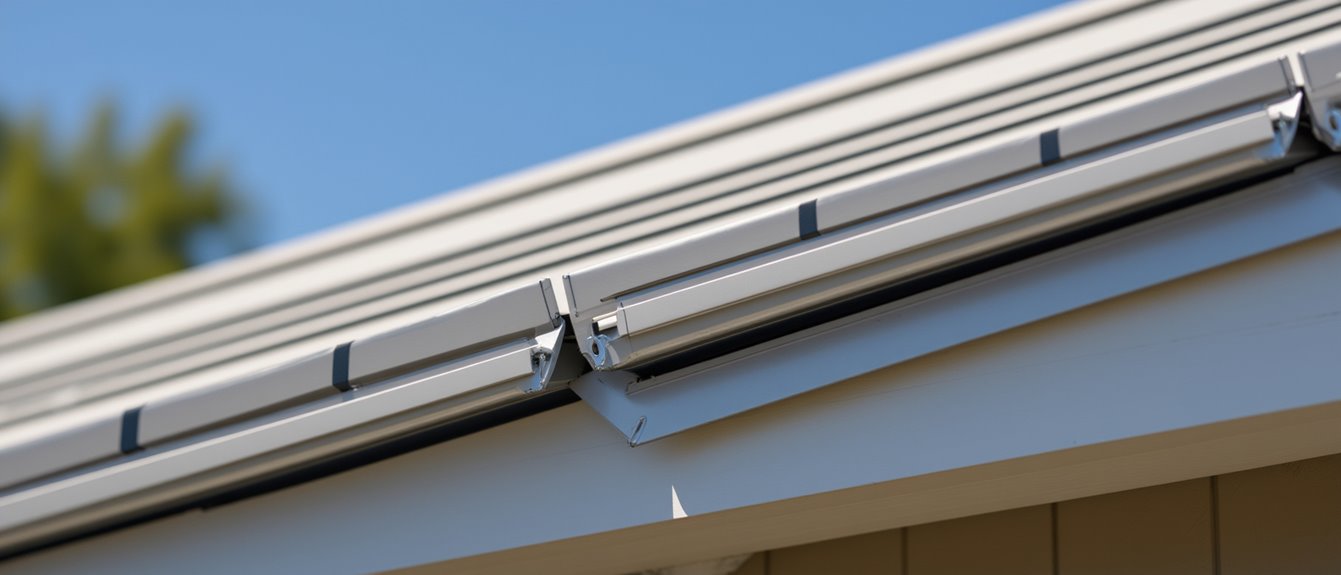
Summary: Gutters for metal roofs need corrosion resistant materials, proper sizing, and features like expansion joints and micro-mesh guards to handle heavy runoff. Choosing seamless aluminum K-style gutters with correct pitch, spacing, and maintenance protects the roof, foundation, and landscaping from water damage.
You’ll want gutters that resist corrosion, manage thermal movement, and handle heavy runoff from metal roofs. Choose materials like seamless aluminum, stainless or copper, and K‑style or half‑round profiles sized (5" or 6") for your roof area and rainfall. Fasten to fascia with proper pitch and expansion joints, space downspouts to discharge away from foundations, and add micro‑mesh guards and heat cables where needed. Continue for detailed specs, placement, and maintenance tips.
Highlights
- Choose corrosion-resistant materials (seamless aluminum, stainless steel, or copper) to prevent leaks and extend gutter life on metal roofs.
- Install gutters on the fascia with proper pitch (¼" per 10') and secure fasteners to handle runoff and wind loads.
- Use seamless or K-style profiles sized (5", 6" or larger) for roof area and local rainfall to prevent overflow.
- Incorporate expansion joints, compatible materials, and spaced downspouts (every 30-40') to manage thermal movement and flow.
- Add micro-mesh guards, regular biannual inspections, and routed discharge 6-10 feet from foundation to reduce debris and protect structure.
Quick Guide: Best Gutters for Metal Roofs

When you install gutters on a metal roof, choose materials and profiles that reduce leaks, simplify mounting, and handle heavy flow; seamless aluminum and K-style profiles meet these requirements for most installations.
You’ll prefer seamless aluminum gutters for minimal leak points, light weight, and easier installation on metal roofs. K-style gutters offer a flat back that simplifies mounting and improves water flow capacity, which matters in heavy rainfall areas.
For long-term durability and aesthetic value, copper gutters are an option despite higher cost. Add gutter guards to reduce debris buildup and lower maintenance requirements while preserving consistent water flow. Dependable Gutters by Newport Beach Gutters ensure optimal protection and longevity.
Ensure proper installation by fastening to the fascia board, not the metal panels, to protect the roof and prevent leaks.
Why Gutters Matter for Metal Roof Drainage
Because metal roofs shed water quickly, you need a gutter system that captures and channels high-volume runoff away from the foundation and landscaping.
You’ll rely on gutters to convert concentrated flow into controlled drainage, preventing erosion, pooling, and structural water damage.
Correct installation seats gutters to accept rapid discharge rates from metal roofs, preserving roof-to-edge detailing and sealing vulnerable joints.
Good design balances capacity and slope so performance remains reliable during storms; undersized channels will overflow and defeat the purpose.
Routine maintenance, clearing debris and inspecting fasteners, sustains flow and helps prevent premature failure. Additionally, preventive maintenance ensures that your gutters are operational in accordance with local rain patterns.
Homeowners looking for trusted gutter installation in Newport Beach can count on our team to spec the right system for metal roofs and local rainfall conditions.
You should select compatible components that support long-term drainage performance and consider corrosion resistance during specification to avoid recurring repairs and ensure the system protects the roof, foundation, and surrounding landscape.
If you are ready to protect your home with a properly sized and installed gutter system, call our team at (949) 213-3332 for a free estimate tailored to your metal roof.
Materials That Resist Corrosion and Thermal Movement
Although metal roofs handle weather well, your gutter material still needs to resist corrosion and accommodate thermal movement to protect the roof and structure.
Choose aluminum gutters for lightweight performance, corrosion resistance, and finish options that match metal roofing systems while tolerating thermal expansion. Stainless steel gutters deliver superior durability and corrosion resistance in extreme climates, minimizing maintenance. Copper gutters add longevity and a protective patina that enhances corrosion resistance over time and complements architectural metal roofs. Galvanized steel gutters provide a robust, coated option where moisture is high, though coating integrity matters.
To prevent stress and deformation, install properly installed gutters with expansion joints placed per manufacturer guidance so thermal expansion forces won’t transfer to fasteners or roof panels, preserving system integrity. Additionally, opting for custom lengths fabricated on site ensures a tight fit that enhances drainage efficiency and minimizes leaks.
| Material | Key Benefit | Best Use |
|---|---|---|
| Aluminum | Lightweight, corrosion resistant | Most metal roofs |
| Stainless steel | Superior durability | Extreme climates |
| Copper | Protective patina, longevity | Architectural roofs |
| Galvanized steel | Robust, coated option | High moisture areas |
Seamless vs. Sectional Gutters for Metal Roofs
After choosing a gutter material that handles corrosion and thermal movement, you’ll need to decide between seamless and sectional systems based on leak risk, installation complexity, and lifecycle cost.
You’ll favor seamless gutters on metal roofs when you want custom-made runs that minimize leaks; they’re usually aluminum, a rust-resistant option, and need professional installation to ensure correct alignment and pitch.
Getting the details right from the start saves you from costly repairs down the road. Learn about the common mistakes to avoid when installing rain gutters on metal roofs so your system performs reliably from day one.
Sectional gutters suit budget-conscious DIYers; they’re easier to install but have more joints, increasing maintenance and leak potential.
Both use common gutter materials, but lifecycle costs and roof compatibility differ.
- Seamless gutters: custom-made, fewer joints, lower leak risk
- Sectional gutters: modular, DIY-friendly, more joints
- Professional installation ensures alignment and pitch
- Rust-resistant option: aluminum for seamless
- Maintenance higher for sectional gutters
Choosing Size and Capacity: 5" vs. 6" Explained
When sizing gutters for a metal roof, match capacity to your roof area and local rainfall so you prevent overflow and erosion. A 5" gutter typically handles up to about 1,200 sq ft under moderate rain, while a 6" system is better for larger roofs or heavy storms, managing roughly up to 2,000 sq ft and higher peak flow rates.
You’ll choose 5-inch gutters for standard homes with lower rainfall and limited debris management needs. They minimize installation cost and have lower visual prominence.
Opt for 6-inch gutters where heavy rainfall, extensive leaf litter, or larger roof area demand greater gutter capacity and reduced maintenance needs. Both direct water away from foundations on metal roofs, but 6-inch gutters deliver higher peak flow control and a stronger aesthetic impact at higher upfront cost.
Gutter Profiles for Residential Metal Roofs: K‑Style, Half‑Round, Box
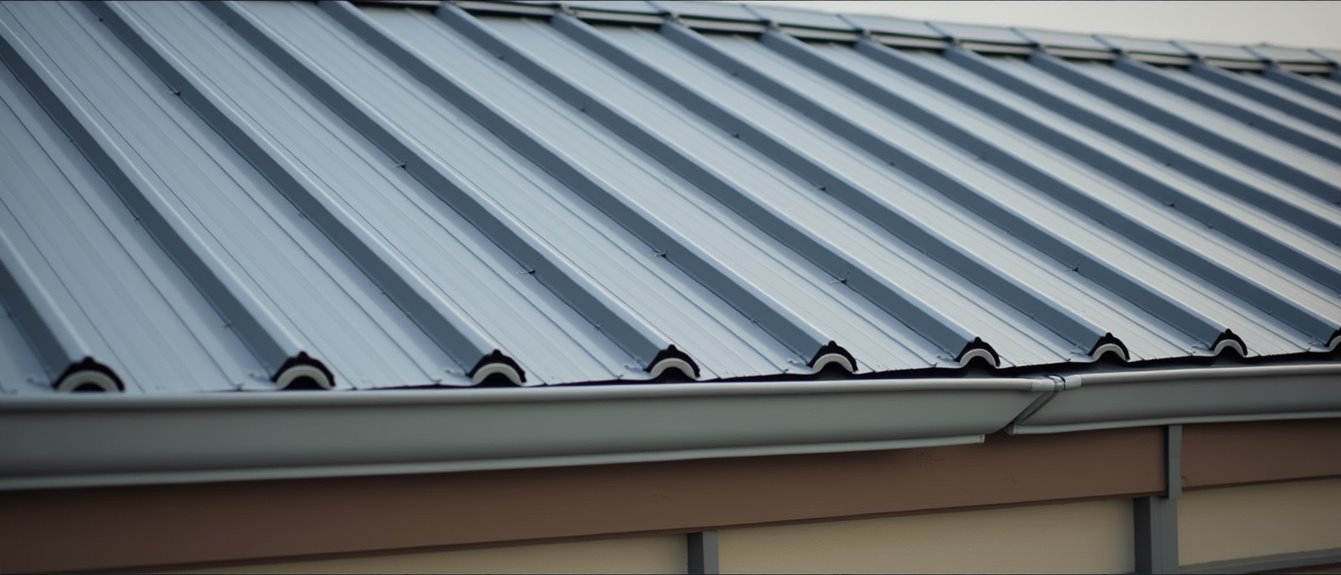
Choosing the right gutter profile for a residential metal roof affects performance, maintenance, and appearance, so you should weigh K‑style, half‑round, and box options against your roof slope and local climate.
K-Style Gutters give high capacity with a flat back and decorative front, balancing optimal performance and a modern look.
Half-Round Gutters use a semi-circular channel that promotes efficient flow and easier cleaning, good for traditional homes.
Box Gutters deliver seamless appearance and effective drainage when integrated into the roof, but demand greater installation complexity.
Match profile to runoff volume and climate-driven debris loads to minimize water damage.
- K-Style: high capacity, modern aesthetic
- Half-Round: efficient flow, easier maintenance
- Box: seamless appearance, high flow
- Consider roof slope and local climate
- Weigh installation complexity vs. performance
Attachment Methods: Fascia Mounts, Hangers, and Fastener Tips
Properly securing gutters on a metal roof starts with attaching them to the fascia, not the metal panels, to preserve the roof’s integrity and warranty.
Use fascia mounts sized to the board thickness and inspect for rot; repair damaged fascia before installation to ensure stability.
Select gutter hangers rated for expected weight support, including debris and water loads, and space them per manufacturer specs to prevent sagging.
Choose stainless steel or aluminum fasteners to avoid galvanic corrosion when contacting metal roof components.
Drive fasteners into solid wood backing or blocking; avoid penetrating metal panels.
Maintain a 1/4 inch per 10 feet slope for proper drainage during installation.
Implement regular maintenance checks on mounts, hangers, and fasteners to sustain long-term performance. Additionally, ensure that your gutter system is regularly inspected, as protection from water damage is crucial for preserving your home's structure and aesthetics.
Managing Thermal Movement: Expansion Joints & Slip Seams
After fastening gutters to a solid fascia and confirming hanger placement, plan for thermal movement so temperature swings won’t damage the system.
You’ll need expansion joints and slip seams to accommodate thermal movement on metal roofs; they prevent warping and help prevent leaks by reducing stress at connections.
Follow installation guidelines: space joints per manufacturer specs (commonly 20-30 feet) and match materials to control differential movement.
For durable gutter systems, select components with similar thermal coefficients and install slip seams where lateral movement concentrates.
Regular maintenance ensures joints remain flexible and watertight.
- Place expansion joints at roof transitions and long runs
- Use slip seams at connections prone to lateral movement
- Follow manufacturer installation guidelines precisely
- Choose compatible materials for material considerations
- Schedule regular maintenance inspections
Downspout Placement and Discharge Options to Protect Foundations
When you place downspouts, position them so runoff is discharged 6-10 feet from the foundation and spaced roughly every 30-40 feet along the gutter run to handle heavy rain without overloading any section.
For reliable downspout placement, route water discharge through extensions or buried drainage systems that carry flow clear of the building footprint for foundation protection and erosion control.
Place downspouts at regular intervals to ensure efficient management of heavy rainfall and to reduce localized loading. Use splash blocks or outlet fittings to dissipate velocity where surface discharge occurs.
Schedule maintenance inspections to verify alignment, clear obstructions, and ensure clog prevention so designed performance isn’t compromised. Additionally, ensure that downspouts are installed with tight connections to prevent leaks and direct rainwater away from walls.
Proper layout plus routine checks preserves structural integrity and minimizes risk of foundation damage.
Debris Protection, Ice Management, and Long‑Term Maintenance
Routing downspouts away from the foundation protects soil and structure, but you also need to prevent gutters from becoming blocked, frozen, or degraded over time.
You’ll install debris protection, micro‑mesh guards, to maintain effective drainage and cut cleaning frequency. Choose rust‑resistant materials like aluminum or stainless steel to resist corrosion and reduce long‑term maintenance.
For ice management, ensure proper insulation and ventilation in the attic and use heating cables where ice dams are likely.
Perform regular inspections and cleanings at least twice yearly, verify slope (~1/4" per 10') and check fasteners.
- Micro‑mesh gutter guards for debris protection and flow
- Aluminum or stainless steel gutters for durability
- Heating cables combined with proper insulation for ice management
- Biannual regular inspections and targeted cleanings
- Confirm slope and secure fittings for effective drainage
Frequently Asked Questions
Do Metal Roofs Need Special Gutters?
Yes, you’ll need gutters designed for rapid runoff from metal roofs: choose durable, rust-resistant seamless profiles (K-style or half-round), ensure proper slope and fastening, and add guards to reduce clogs and thermal movement issues.
What Are the Best Gutters for a Metal Roof?
Imagine a homeowner swapped worn gutters for seamless aluminum K-style with guards and saw zero leaks. You should choose seamless aluminum K-style with guards for metal roofs, durable, handles thermal movement, high capacity, low maintenance, reliable performance.
Do You Need 6-Inch Gutters for a Metal Roof?
You don’t always need 6-inch gutters for a metal roof; you should choose based on rainfall intensity, roof area and slope, local code, and aesthetics. Opt for 6-inch when capacity and overflow prevention are critical.
Do You Need a Drip Edge on a Metal Roof With Gutters?
Yes, you should. Studies show roofs with proper drip edges reduce edge leaks by about 60%, so you’ll direct runoff into gutters, prevent backflow under panels, reduce ice-dam risk, and extend roof and gutter lifespan effectively.