

Summary: Most homes use 5 inch gutters, while 6 inch gutters suit large or steep roofs, heavy rainfall, long runs, or multiple valleys. Size gutters using adjusted roof square footage and pitch, match downspouts accordingly, and consider material and professional installation for lasting performance.
Homes typically use 5‑inch or 6‑inch gutters; you’ll pick 5‑inch for average roofs with moderate slope and rainfall, and 6‑inch when you’ve got large roof areas, steep pitches, heavy rains, long runs or multiple valleys. Match bigger gutters with larger downspouts and factor roof square footage (adjusted for pitch) when sizing. Material and installation affect performance, so consider aluminum, steel or copper and professional fitting, keep going to see practical sizing and layout tips.
Highlights
- Common residential gutter sizes are 5-inch and 6-inch K-style profiles, with 5" for typical homes and 6" for larger roofs.
- 6-inch gutters handle roughly 40-50% more water, suitable for roofs over ~5,500 sq ft or steep pitches.
- Choose gutter size based on roof area, pitch (use pitch multipliers), and local rainfall intensity.
- Downspout capacity must match gutter size, larger gutters require larger or more downspouts for proper drainage.
- Material affects size options and longevity: aluminum is common, copper is premium, and steel needs rust protection.
Standard Gutter Size (5" Vs 6") and Why It Matters

While 5-inch gutters are the standard choice for most homes, you should consider 6-inch gutters if your roof is large, steep, or you get heavy rainfall.
6-inch systems can handle roughly 40-50% more water and prevent overflow on roofs over about 5,500 sq ft or with aggressive pitches. Conversely, 5-inch gutters (3½" deep) remain appropriate for average-sized houses with moderate slopes and typical precipitation.
You’ll pick between the standard gutter size and upsized options by assessing roof pitch, roof area, and typical rainfall.
5-inch gutters suit average roof designs and provide solid home protection when rainfall is moderate.
6-inch gutters boost water flow capacity for heavy rainfall and steep roofs.
Thoughtful gutter sizing is central to effective water management and long-term damage prevention. Additionally, opting for custom-fit seamless gutters can enhance your home’s protection against water damage and foundation issues.
Quick Decision: 5‑Inch or 6‑Inch - Who Needs Which
Now that you know how 5‑inch and 6‑inch gutters differ in capacity and when each is typically used, you can make a quick, practical choice based on three measurable factors: your roof’s adjusted square footage, its pitch, and your region’s rainfall or snow load. Decide like this: choose 5-inch for average roofs and standard sizes where runoff is moderate; pick 6-inch for heavy rainfall, steep roofs, or larger surface areas to reduce overflow and water damage. Check downspout compatibility, 6-inch needs larger downspouts to avoid bottlenecks. As a homeowner, balance cost versus protection: 6-inch protects better against overflow; 5-inch fits most gutter system needs. Additionally, consider the benefits of custom hangers and drainage checks to enhance your gutter system's efficiency.
| Factor | 5-inch | 6-inch |
|---|---|---|
| Capacity | Moderate | 40-50% more |
| Best for | Average homes | Heavy rainfall |
| Downspouts | Standard | Larger needed |
| Overflow risk | Higher on big roofs | Lower |
Calculate Your Roof’s Adjusted Square Footage
Because roof pitch changes how much rain your roof sheds, you’ll first measure each roof section’s length and width and multiply them to get the flat area.
Then adjust that area by a pitch multiplier to account for slope. You’ll use the adjusted square footage to guide gutter installation choices and match standard gutter sizes to expected runoff.
- Measure each section: length × width to get roof size.
- Find pitch: use a level to measure rise over 12" and identify the pitch multiplier.
- Calculate adjusted square footage: flat area × pitch multiplier (e.g., 4/12 = 1.07, 12/12 = 1.25).
- Decide gutter sizes: compare adjusted area with rainfall intensity to choose 5‑inch, 6‑inch, or larger gutters for your home's exterior. Additionally, consider custom sizing options available to ensure optimal water management.
When to Choose 6‑Inch (Or Larger): Pitch, Rainfall, and Valleys
If your roof has a steep pitch, frequent heavy rains, or long, converging valleys, choose 6‑inch (or larger) gutters to handle the increased water flow and reduce overflow risk.
6‑inch gutters typically move about 40-50% more water than 5‑inch systems, and they’re recommended for roof areas over roughly 5,530 sq ft or for sections where multiple roof planes channel into a single run.
You’ll opt for larger gutters when roof pitch accelerates runoff, when rainfall data shows intense or frequent storms, or when complex roof valleys concentrate flows.
Selecting 6-inch standard sizes improves water management and provides adequate drainage to limit overflow and protect your foundation. Additionally, regular gutter cleaning ensures optimal performance and prevents debris buildup that could impede drainage.
Assess local rainfall data and roof geometry to decide if 7-8 inch upgrades are warranted.
Matching Downspouts: Size, Count, and Placement
When you match downspouts to your gutters, size, count, and placement determine whether water actually leaves the roof instead of pooling or overflowing. Choose 2x3-inch downspouts for standard 5-inch gutters and 3x4-inch for larger 6-inch systems.
Increase count where runs exceed recommended lengths or roof area and rainfall intensity demand it. You’ll size and space downspouts to maintain steady water flow and effective drainage. Follow common sizes and placement rules to protect foundations and landscaping.
- Use 2x3 for 5-inch runs; one downspout per 40 feet minimum to manage water flow.
- For 6-inch gutters, 3x4 handles longer runs, up to about 60 feet, before adding another.
- Let roof area and rainfall dictate downspout count.
- Place downspouts at corners or low points for proper downspout placement. Additionally, ensuring proper gutter maintenance helps prevent clogs and overflow that can compromise your drainage system.
Residential Gutter Materials & Thickness (Aluminum, Copper, Steel)
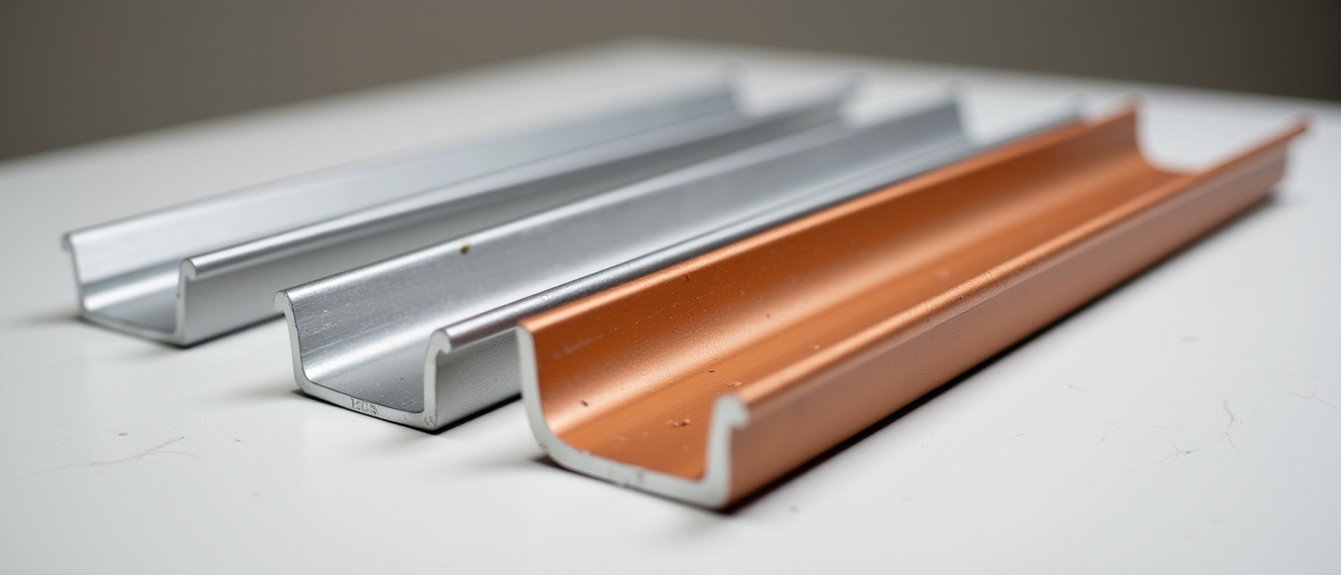
Though your budget and climate will steer the final choice, three materials, aluminum, copper, and steel, dominate residential gutters because each balances weight, durability, and cost differently. You’ll pick aluminum gutters (0.019-0.032") for lightweight, rust-proofing benefits and good material durability in most residential applications. Copper gutters (16-24 gauge) cost more but give exceptional longevity and distinct patina. Steel gutters (24-30 gauge, commonly 26) offer strength but often need rust-proofing to last.
| Material | Typical thickness | Notes |
|---|---|---|
| Aluminum | 0.019-0.032 in | Lightweight, rust-resistant |
| Copper | 16-24 gauge | Long lifespan, costly |
| Steel | 24-30 gauge | Strong, need rust-proofing |
| Selection tips | Varies | Balance cost considerations and home protection |
Common Gutter Layouts (Valleys, Long Runs) and Recommended Sizes
Think of roof valleys and long runs as concentrated water highways that often need larger gutters to keep flow controlled; you’ll want properly sized sections where water flow is greatest.
Consider common gutter layouts and where 6-inch gutters are most useful.
- Valleys: where multiple roof planes meet concentrate runoff, use 6-inch gutters for heavy rainfall and complex rooflines.
- Long runs: over ~40 feet, 6-inch gutters reduce overflow and limit extra downspouts.
- Steeper roofs: increased water flow from pitch favors larger gutter sizes to prevent backups.
- Complex rooflines: multiple valleys and varied flows may require 6-inch or oversized gutters to handle peak discharge.
Plan layouts around these points so your system manages heavy rainfall efficiently and protects the structure.
Professional Installation, Seamless Systems, and Custom Sizing
Because correct slope and tight seams make the difference between a long-lasting system and constant repairs, you should hire a professional who’ll measure, form, and install gutters to the exact pitch your roof needs.
With professional installation, licensed contractors assess local rainfall patterns and your roof’s characteristics to recommend the right gutter size and durable materials.
Seamless systems are fabricated on-site to fit unique roof designs, minimizing joints where leaks start and simplifying water management needs.
Custom sizing lets you choose thicker aluminum gutters, commonly 0.032 inches, for better weather resistance and longer life.
You’ll get precise placement of downspouts and pitches so runoff is controlled, debris clearance is optimized, and maintenance intervals are reduced, avoiding recurring repair costs.
Frequently Asked Questions
What Is the Most Common Residential Gutter Size?
Think of a trusty 5-inch gutter as your roof’s standard umbrella; you’ll choose it most often. It’s deep enough for average homes, handles moderate rain, and typically requires one downspout under forty feet.
Should I Get 6 or 7 Inch Gutters?
Choose 6-inch gutters unless your roof is extremely large, very steep, or rainfall is relentless; they boost capacity, fit most downspouts, and balance cost and performance, but pick 7-inch for exceptional roof area or intense storm exposure.
What Looks Better, 5 or 6 Inch Gutters?
Like a tailored suit, 5-inch gutters suit modest roofs for a balanced, subtle look, while 6-inch gutters give larger or steeper homes a sturdier, cleaner appearance in heavy rain; choose based on roof size and style.
What Length Gutters Does a 2000 Sq Ft House Usually Have?
You’ll typically need about 150 to 200 linear feet of gutters for a 2,000 sq ft house, though your roof layout and pitch can change that, so you should get a professional assessment to confirm exact length.